Binaural space · VST3 · AU · CLAP
Loko
Put a sound somewhere around the listener's head - at a bearing, a height and a distance that can be pointed at, rather than somewhere on a line between two speakers. Built for headphones.
See it in action
Loko, in a minute.
Why a model of a head
A pan pot changes level. Ears barely use it.
A pan pot changes the level of two channels, and that's all it does. Real ears locate a sound from three other cues, and Loko renders all of them.
Time
A source on the left reaches the left ear first, by up to three quarters of a millisecond.
Shadow
The head blocks high frequencies on their way to the far ear, so that ear hears the sound darker.
The outer ear
Its folds carve notches into the spectrum that move as a source rises. That's how height is heard, and part of what tells front from back.
Computed, not recorded
A render, not a photograph.
The usual way to get these cues is to record them, with microphones in the ears of a real or dummy head. Loko computes them instead, from a physical model: a 20 cm sphere for the head and a simplified outer ear. A camera can only shoot what was in front of it, while a render can show a scene that never existed and still look right. That trade buys two things a recording can't do.
Take the ear out, keep the head
A recorded response has the ear's colour baked into every direction. In Loko the outer ear is a stage of its own: switching 3D off removes height and the ear's colouring, while left, right and distance stay as they were.
Bring a source right up to the ear
Recorded responses are almost always taken a metre or two away. A sphere has an answer at any distance, so a source at 2 cm sounds like it's at the ear - a different thing from a loud source further away.
How it works
Each ear gets its own path.
- Delay The travel time around the head. The difference between the ears is the time cue.
- Head shadow The far ear loses top end as the source swings round; the near ear gains up to 6 dB.
- Near field Inside about a metre the ears drift apart, up to about 29 dB at the closest distance.
- Air absorption Following the ISO standard: at 200 m a source is 21 dB down at 8 kHz, on top of being quieter.
- Outer ear Two resonances and three notches, modelled on the most representative ear in a public database of measured heads.
- Limiter One, at 0 dBFS, with the same gain on both ears. Below full scale the signal comes out bit for bit.
Loko renders the direct sound only, with no reflections and no tail. The room belongs in a reverb on a send, after Loko - Chambro, for instance.
The whole interface
One disc, five dials.
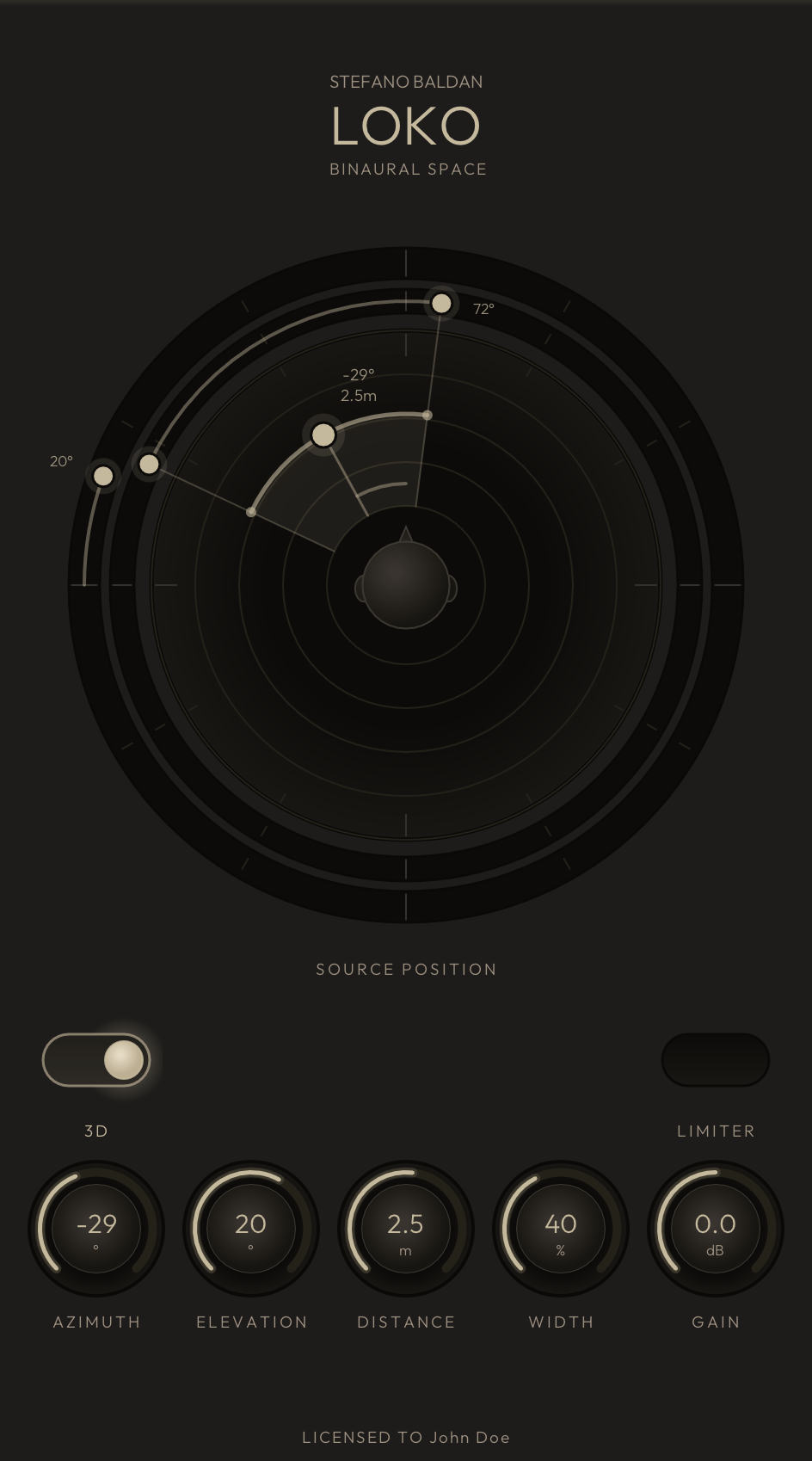
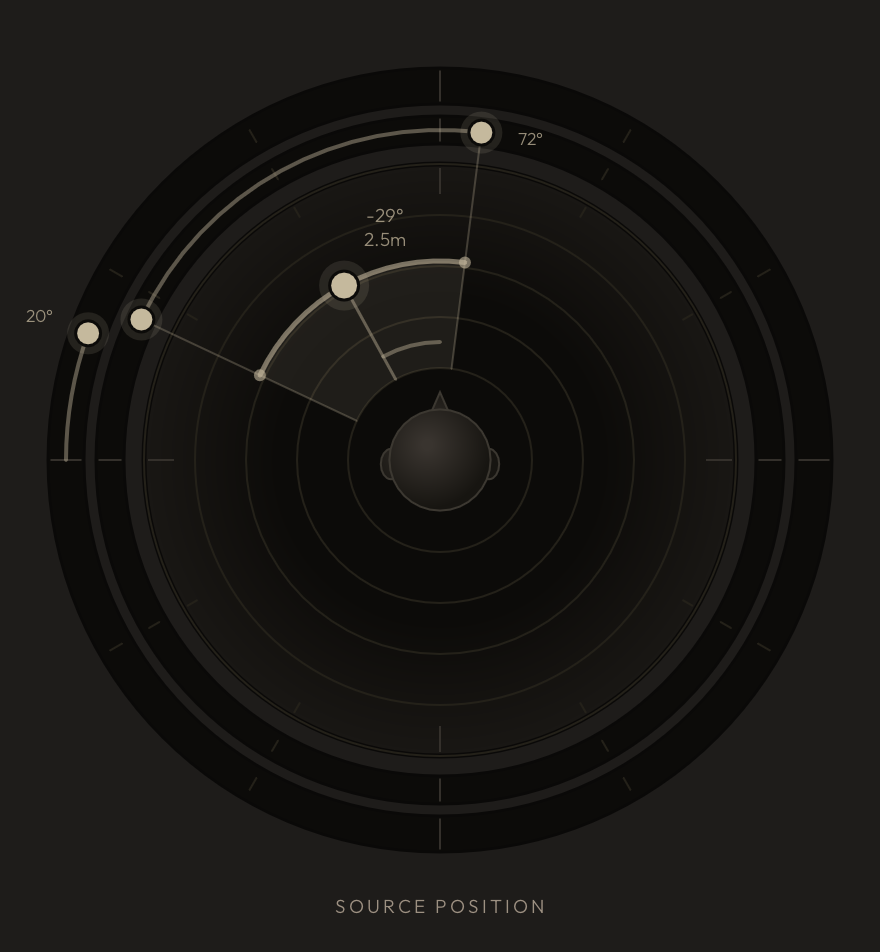
The pad is the view from above, with the head facing up the screen: the dot's bearing is Azimuth and its distance from the head is Distance. The outer ring is Elevation, the inner ring is Width. The rings sit at 0.02, 0.2, 2, 20 and 200 m, so the close range gets as much room on screen as the far one.
- Azimuth −180° to +180°
- Elevation −90° to +90°
- Distance 2 cm to 200 m, 0 dB at 2 m
- Width 0 to 100%, for stereo sources
- Gain −48 to +48 dB, ahead of the limiter
- 3D Off leaves a strictly two-dimensional head
Latency, on purpose
The delay is the effect.
A source 200 m away arrives about 583 ms late, and Loko reports zero latency so the host doesn't compensate it away. Because the delay follows the distance, a fast sweep bends the pitch the way a passing siren does: the Doppler effect, for free. Push a part back with Distance before reaching for the fader: the delay and the duller top end come along with the drop in level.
Made for everyone
Keyboard, screen readers, no accounts.
Accessible from the first release
Every control is reachable with Tab and nudged with the arrow keys, and the disc takes four Tab stops. Loko works with VoiceOver, NVDA, JAWS and Narrator, and every control has a spoken name and value.
A license file, checked offline
A purchase comes with a license file by email. It's checked on the computer itself, with no connection, account or activation, and it keeps working on a new machine.
Compatibility
Drops into your session.
- Formats VST3 · Audio Unit · CLAP
- macOS 10.15+ · Apple Silicon & Intel
- Windows 64-bit
- Latency Reports zero, on purpose
Loko places the source, Chambro builds the room around it. The bundle is one license file for both.