Room reverb · VST3 · AU · CLAP
Chambro
A reverb that asks for a room's dimensions in metres, and for what its walls are made of. Type in 9 × 18 × 8 and the result is a chapel, because that's what a room that size does to sound.
See it in action
Chambro, in a minute.
Why a model of a room
A description, not a parameter space.
Most reverbs describe a space in abstractions: size, density, a room dial from 0 to 100. I build instruments that model physical things, and one conviction runs through all of them: when the controls are physical quantities - a length, a material - they stop needing to be hunted. "Nine metres wide, stone walls" is a setting anyone can picture, and one that matches a room that could exist is heard as a place instead of audited as an effect.
Modelled, not captured
Plausible rooms, including impossible ones.
An impulse response is a photograph of a room: exact, and frozen at one size, one material and one decay. Chambro is a render. Every setting obeys the physics of rooms, and because the settings are independent, rooms that can't exist are within reach.
A chapel in bathroom tiles
The shape of a chapel with the walls of a tiled bathroom.
A crypt that rings for a minute
Stone walls, and a tail up to 60 seconds long.
Mirrors, or perfect scatterers
Walls at either extreme of roughness, and everything in between.
A room that grows
From a vocal booth into a hall over the course of a song.
How it works
Sixteen lines, tuned to the room.
At certain frequencies - a room's modes - sound bouncing between the walls lines up with itself and rings on. The dimensions alone set those frequencies, which is why a bathroom sings a note. Inside Chambro are sixteen delay lines, each tuned to one of those modes: move a wall and every line moves with it.
The lines feed back into each other through a mixer that's exactly lossless, so the only thing shortening the tail is the absorption that was asked for. The Time dial means what it says.
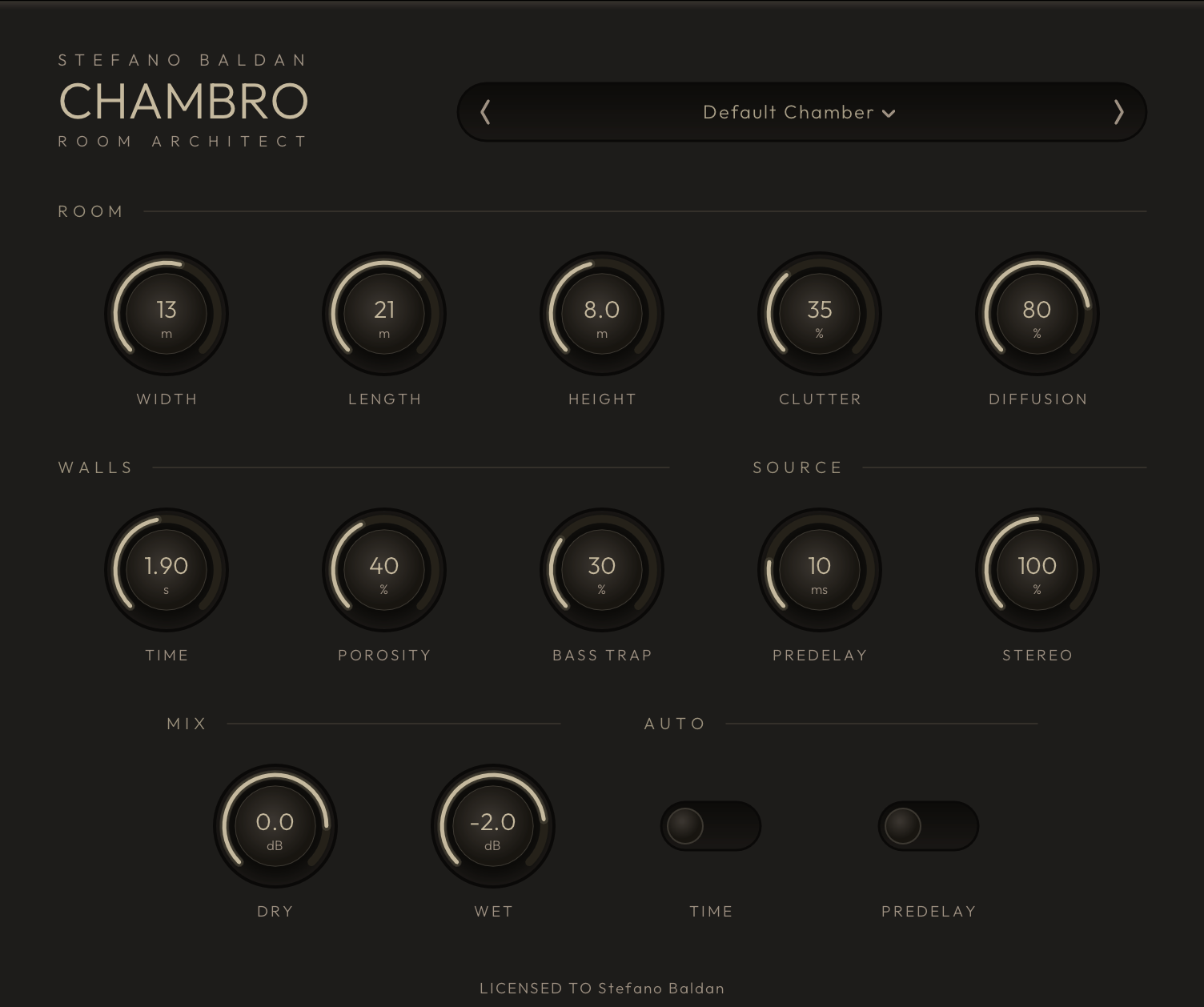
The whole interface
Size sets the character. Material sets the length.
- Width · Length · Height 1 to 100 m each
- Clutter How far the room is from an empty box
- Diffusion How much the walls scatter
- Time 0.1 to 60 s
- Porosity How open the surfaces are, and so how much of the top of the tail they swallow
- Bass Trap How much they flex, and so how much of the bottom they trap
- Predelay 0 to 250 ms
- Stereo 0 to 200%, dry stays put
- Dry · Wet Levels in dB
Porosity is really a material dial. A 4 × 5 × 3 m room, changing nothing else:
- 12% · 2.4 s Bare stone, tile
- 30% · 1.4 s Plaster, bare wood
- 48% · 0.8 s A rug, some furniture
Bass Trap is the same question at the other end, and a different answer. Low frequencies aren't soaked up by soft things; they're trapped by what flexes and resonates with them - panelling, plasterboard, a sprung floor. Stone and tile don't flex, so they hand the bass straight back. Turn it up and the bottom of the tail shortens while the middle stays put, which is how a real room decays.
Auto
Let the room decide.
Two switches hand Time and Predelay over to the physics. Drag a wall out and the decay lengthens, as it would.
Auto Time
Sabine's equation, the acousticians' standard for predicting how long a real room reverberates: T60 = 0.161 × volume ÷ (surface × absorption). Volume and surface come from the dimensions, absorption from Porosity. Bass Trap is left out on purpose: it already shortens the tail by itself, and counting it twice would make every derived room too short.
Auto Predelay
The mean free path - the average distance sound travels between two reflections - divided by the speed of sound. A vocal booth answers in 4 ms, a cathedral in 67.
Presets
Sixteen rooms to start from.
Most are real kinds of space at real dimensions, with the decay Sabine's equation gives for their size and materials. That's why the Tiled Bathroom, at 2.2 × 3.0 × 2.5 m, rings longer than the Drum Room at six times its volume. A few, like the Infinite Cavern and the Frozen Cathedral, are the impossible kind.
A tip from the manual: reach for Predelay before less Wet. Most "too much reverb" is really "reverb too early".
Made for everyone
Keyboard, screen readers, no accounts.
Accessible from the first release
Every control is reachable with Tab and nudged with the arrow keys, preset bar included. Chambro works with VoiceOver, NVDA, JAWS and Narrator, and every control has a spoken name and value.
A license file, checked offline
A purchase comes with a license file by email. It's checked on the computer itself, with no connection, account or activation, and it keeps working on a new machine.
Compatibility
Drops into your session.
- Formats VST3 · Audio Unit · CLAP
- macOS 10.15+ · Apple Silicon & Intel
- Windows 64-bit
- Presets 16 rooms, real and impossible
Chambro builds the room, Loko places the source inside it. The bundle is one license file for both.